
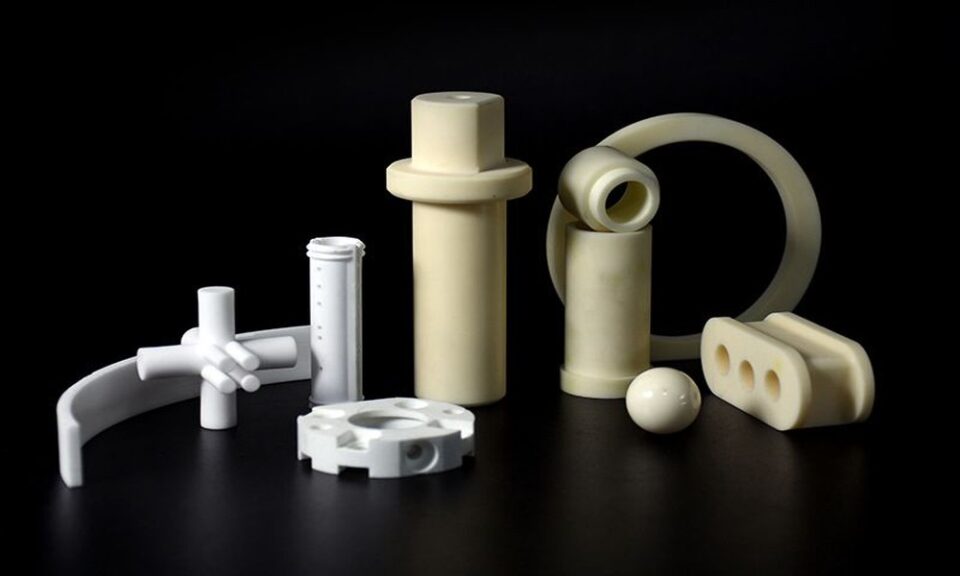
What Alumina Injection Molding Produces
Alumina injection molding is the application of ceramic injection moulding technology specifically to aluminium oxide, or alumina, producing net-shape ceramic components with complex geometries and dimensional tolerances that conventional alumina shaping methods cannot achieve economically. Alumina is the most widely used technical ceramic material, specified for applications requiring a combination of high hardness, electrical insulation, chemical stability, and wear resistance. Conventional shaping methods for alumina – including dry pressing, slip casting, and tape casting – are effective for simple geometries but limited when the part requires internal features, undercuts, or complex external profiles. Alumina injection moulding removes those geometric constraints.
The Properties That Make Alumina the First Choice
Alumina injection molding produces components whose material properties reflect alumina’s distinctive combination of characteristics. Electrical resistivity of approximately 10 to the power of 14 ohm-centimetres makes alumina an effective electrical insulator across a wide temperature range, suitable for applications from room temperature through several hundred degrees Celsius. Hardness of 9 on the Mohs scale provides excellent wear resistance in abrasive environments, extending component life in pump components, cutting tools, and bearing surfaces where metals would wear rapidly. Chemical stability across a wide pH range makes alumina suitable for contact with acids, alkalis, and solvents that would corrode or react with metallic alternatives.
Alumina’s biocompatibility – demonstrated across decades of clinical use in orthopaedic implants and dental restorations – makes it a preferred material for medical device components where long-term contact with biological tissue is required.
The Process Sequence for Alumina Injection Molding
Alumina ceramic injection moulding follows a four-stage process. Feedstock preparation blends fine alumina powder, typically with a median particle size below 5 microns, with a thermoplastic binder system to achieve the flow characteristics needed for consistent mould filling. Injection moulding under controlled temperature and pressure produces the green part in the mould cavity. Debinding removes the binder through staged thermal treatment or solvent extraction, depending on the binder system, without damaging the unfired ceramic body. Sintering at temperatures between 1,500 and 1,700 degrees Celsius densifies the alumina to greater than 99 percent of theoretical density, producing a translucent to opaque body with the mechanical properties the application requires.
Linear shrinkage during sintering for alumina injection moulded parts typically runs between 20 and 22 percent, which must be accurately predicted and compensated for in the tool design.
Applications That Specify Alumina MIM Components
High precision alumina component production serves applications across electronics, medical devices, and industrial equipment. In electronics, alumina components include substrate carriers, hermetic feed-through insulators, and housing components for sensors and connectors where high-frequency electrical insulation, dimensional accuracy, and thermal stability must coexist. In medical devices, alumina components are used for wear-couple surfaces in orthopaedic implants, components in minimally invasive surgical instruments, and diagnostic equipment parts requiring chemical inertness and sterilisability.
“Singapore’s technical ceramics industry has grown by serving the world’s most exacting engineering applications,” noted the Singapore Institute of Manufacturing Technology in its advanced materials programme overview, reflecting the calibre of applications that alumina injection moulding typically serves.
Dimensional Control in Alumina Injection Molded Parts
Alumina injection molding achieves dimensional tolerances of plus or minus 0.3 to 0.5 percent of nominal dimensions as sintered. On critical functional surfaces – sealing interfaces, bore diameters, and precision mating surfaces – grinding and lapping operations after sintering can bring dimensions within tighter bands. The hardness of sintered alumina makes post-sintering machining possible but costly; minimising the requirement for post-sintering material removal through accurate tool design and process control reduces the overall production cost.
Surface finish as sintered is typically Ra 0.8 to 1.6 micrometres. Lapping can achieve Ra values below 0.1 micrometres on flat surfaces, suitable for optical, sealing, and precision mating applications.
Alumina Compared to Other Technical Ceramics
Alumina ceramic component manufacturing produces components with a specific balance of properties. Zirconia provides higher fracture toughness and flexural strength at the cost of lower hardness and higher material cost. Silicon nitride provides better high-temperature strength and thermal shock resistance but requires more demanding sintering conditions. For applications where the combination of electrical insulation, hardness, chemical stability, and cost-effectiveness is required, alumina remains the material of choice across the broadest range of technical ceramic applications.
The choice between alumina grades – 96 percent alumina for cost-sensitive applications, 99 percent or higher for applications requiring maximum hardness and purity – depends on the performance specification and the regulatory context.
Why Injection Moulding Is Chosen for Complex Alumina Parts
Alumina injection molding is the forming method of choice for alumina components that require internal features, thin walls, complex external profiles, or the dimensional consistency needed for high-volume production. Pressing produces only simple geometries. Machining of sintered blanks is effective on flat surfaces and simple bores but slow and expensive for complex geometries in a material of Mohs 9 hardness. Injection moulding produces the near-net shape in a single forming operation, limiting post-sintering machining to surfaces where tolerances tighter than the as-sintered capability are required.
Alumina injection molding delivers high precision ceramic components with the geometric complexity and dimensional accuracy that demanding electronic, medical, and industrial applications require.
