
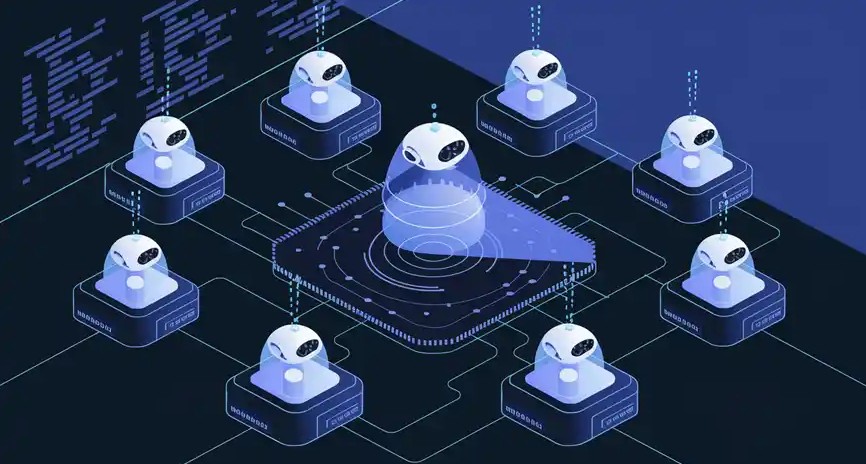
Imagine a busy city intersection where no traffic lights exist, yet every car moves smoothly, anticipating the paths of others and adjusting its own. This coordination—neither random nor dictated by a single authority—is the essence of multi-agent AI systems. These systems consist of multiple autonomous entities (agents) that interact, cooperate, or sometimes compete to achieve individual and collective goals.
In this new era of artificial intelligence, the challenge isn’t merely teaching machines to think—it’s teaching them to think together. The ability of AI agents to make independent yet harmonious decisions is transforming industries from logistics to finance.
Understanding Multi-Agent Intelligence
Think of a football team. Each player has their own goal—to score, defend, or assist—but the ultimate objective is shared: winning the game. Similarly, in multi-agent systems, every agent operates based on local information and limited perception, yet their combined decisions determine system-wide outcomes.
In fields like autonomous vehicles, swarm robotics, and distributed computing, these systems are already reshaping operational efficiency. A car in a connected traffic network might negotiate speed and route decisions with other vehicles to avoid congestion, demonstrating the principle of distributed intelligence in action.
Those exploring how such coordination evolves can gain hands-on experience through an artificial intelligence course in Hyderabad, where machine learning and decision-making algorithms are taught using collaborative agent models.
Cooperation vs. Competition: The Balancing Act
In multi-agent systems, agents don’t always play nice. Sometimes, they must collaborate to achieve common goals—like drones coordinating in disaster rescue missions. Other times, competition arises, such as in stock trading bots vying for profitable trades or autonomous bidders in an online auction.
The tension between cooperation and conflict is what makes these systems fascinating and complex. Game theory forms the backbone of their design, offering mathematical tools to predict how agents behave when their interests overlap—or collide.
When cooperation succeeds, it leads to emergent intelligence greater than the sum of its parts. However, unchecked competition can cause instability or inefficiency, much like overcrowded marketplaces or conflicting algorithms in financial systems.
Communication: The Language of Machines
For agents to coordinate effectively, they must communicate—just as humans do. But instead of words, they use protocols, signals, and shared data environments. This is known as agent communication language (ACL), a structured way for AI entities to exchange information and intentions.
In multi-agent systems, communication isn’t just about sharing data; it’s about trust and interpretation. For example, a robot in a manufacturing line may need to confirm whether a nearby robot has completed its task before proceeding. Miscommunication can lead to errors, collisions, or even complete system breakdowns.
Through simulated environments and real-world datasets, professionals enrolled in an artificial intelligence course in Hyderabad learn to design communication layers that enable machines to collaborate seamlessly—making them a vital part of tomorrow’s intelligent infrastructure.
The Challenge of Decision Coordination
The greatest hurdle in multi-agent AI lies in coordination. Each agent may pursue its own strategy, but without alignment, chaos ensues. Researchers employ algorithms like reinforcement learning and distributed optimisation to synchronise decision-making among agents.
Consider an energy grid powered by multiple sources—solar, wind, and hydroelectric. Each source operates independently, but they must collectively balance energy supply and demand. Multi-agent reinforcement learning allows each system to adapt dynamically, ensuring harmony without central control.
This decentralised approach is paving the way for intelligent cities, autonomous supply chains, and adaptive financial systems where decisions are distributed yet optimised for shared success.
Ethical and Societal Considerations
As multi-agent systems evolve, they raise profound ethical questions. What happens when two AI-driven systems reach conflicting objectives that affect humans—say, in autonomous transport or defence? Who bears responsibility when collaborative AI decisions go wrong?
Ethical frameworks for AI must evolve to address accountability, transparency, and fairness across distributed networks. Multi-agent AI introduces layers of complexity that challenge not only developers but also policymakers and ethicists.
Conclusion
Multi-agent AI systems mark a significant leap in artificial intelligence, mirroring how humans operate in societies—sometimes aligned, sometimes at odds, yet constantly negotiating coexistence. By fostering communication, coordination, and shared intelligence among autonomous systems, we’re inching closer to creating AI ecosystems capable of complex, human-like cooperation.
For professionals looking to explore this advanced field, understanding these concepts can pave the way for designing intelligent systems that operate collectively rather than in isolation. As the world moves towards connected autonomy, the capacity to balance collaboration and competition among machines will shape the next generation of innovation.
